
Why Choosing the Right PEG Grade Matters
Polyethylene Glycol, commonly known as PEG, is a versatile specialty chemical used across pharmaceutical, cosmetic, textile, agrochemical, and industrial manufacturing sectors. Selecting the right PEG grade is critical, since the wrong choice can compromise product stability, processing efficiency, and final formulation performance. As a specialty chemical manufacturer with over 25 years of experience in surfactants and chemical intermediates, RIMPRO India helps formulation teams identify the right Polyethylene Glycol grade for their specific application, supported by consistent manufacturing quality and dependable supply.
How Molecular Weight Influences PEG Performance
PEG is available across a wide molecular weight range, and this molecular weight directly governs how it performs in a formulation:
- Viscosity: Lower molecular weight grades are free flowing liquids, while higher molecular weight grades are thick, waxy solids.
- Solubility: All PEG grades dissolve in water, though the rate of dissolution changes as molecular weight increases.
- Stability: Higher molecular weight grades generally offer greater thermal stability and lower moisture sensitivity.
- Overall performance: The right molecular weight ensures the formulation holds its intended texture, strength, and function during processing and storage.
Getting this match right, between molecular weight and application requirement, determines whether a formulation performs consistently or requires costly rework.
Common Challenges in Selecting the Right PEG Grade
Formulation teams and procurement managers commonly face a few recurring challenges when choosing a PEG grade for specific industrial requirements:
- Difficulty matching molecular weight to the desired viscosity or melting range.
- Inconsistent quality between batches from different suppliers.
- Limited technical guidance on grade substitution or blending.
- Uncertainty around regulatory compliance for pharmaceutical or cosmetic grade material.
- Supply chain disruptions that affect production timelines.
These challenges are compounded when sourcing from suppliers who lack in house technical support or consistent manufacturing standards.
RIMPRO India’s Expertise in PEG Manufacturing and Supply
This is where an experienced manufacturer makes a measurable difference. RIMPRO India brings together technical knowledge of PEG grades, quality focused production processes, and application specific formulation support, helping industrial buyers, formulators, and procurement teams choose the grade best suited to their process and end product. This guide compares commonly used PEG grades and explains how to select the right one for pharmaceutical, cosmetic, textile, paint, agrochemical, and industrial formulations.
What Is Polyethylene Glycol and Why Molecular Weight Matters
Polyethylene Glycol is a polyether compound produced through the polymerization of ethylene oxide. It is available across a broad molecular weight spectrum, ranging from low molecular weight liquid grades to high molecular weight solid waxes and powders. The molecular weight of a PEG grade directly determines:
- Physical state: liquid, semi solid, or solid flake.
- Viscosity and flow characteristics.
- Water solubility and hygroscopicity.
- Melting point and thermal behavior.
- Compatibility with active ingredients and other raw materials.
- Function within the formulation: solvent, lubricant, plasticizer, emulsifier, or binder.
Lower molecular weight PEG grades tend to be clear liquids with high solubility and good solvency power, while higher molecular weight grades behave more like waxy solids with binding, film forming, and lubricating properties. A single grade rarely suits every application, since the right choice depends entirely on the intended function and processing conditions.
PEG Grades Comparison: PEG 400, PEG 600, PEG 1000, and Higher Grades
The section below outlines the general characteristics of commonly used PEG grades, based on average molecular weight ranges.
Low Molecular Weight Grades: PEG 200 to PEG 600
PEG 200, PEG 400, and PEG 600 are clear, viscous liquids at room temperature.
- PEG 200 to 300: Low viscosity, highly hygroscopic, used as a solvent and humectant in liquid formulations.
- PEG 400: One of the most widely used grades. It balances solvency and viscosity, and is commonly used in pharmaceutical ointments, cosmetic formulations, and as a plasticizer.
- PEG 600: Slightly higher viscosity than PEG 400, used where a thicker liquid consistency is needed while retaining water solubility.
These grades are valued for their ability to dissolve both water soluble and certain oil soluble ingredients, making them useful as carriers and solvents.
Medium Molecular Weight Grades: PEG 1000 to PEG 1500
- PEG 1000: Transitions from liquid to a soft paste form, used in semi solid formulations that require moderate consistency.
- PEG 1500: A soft, waxy solid at room temperature, often used in ointment bases and as a binder in specific industrial blends.
Medium weight grades are frequently chosen when a formulation requires structure without the rigidity of a high melting solid.
High Molecular Weight Grades: PEG 4000, PEG 8000, and Above
- PEG 4000: A solid, flaked or powdered form with a defined melting point, widely used as a tablet binder in pharmaceutical formulations and as a lubricant in textile processing.
- PEG 6000: Higher melting point and hardness than PEG 4000, used in coatings, mold release applications, and as a processing aid.
- PEG 8000 and higher: Waxy solids with high melting points, suited for applications requiring film formation, thickening, or slow release characteristics.
Higher molecular weight PEG grades generally show lower hygroscopicity and better thermal stability compared to their liquid counterparts, making them suitable for applications where moisture sensitivity is a concern.
PEG Properties by Molecular Weight: Viscosity, Solubility, and Stability
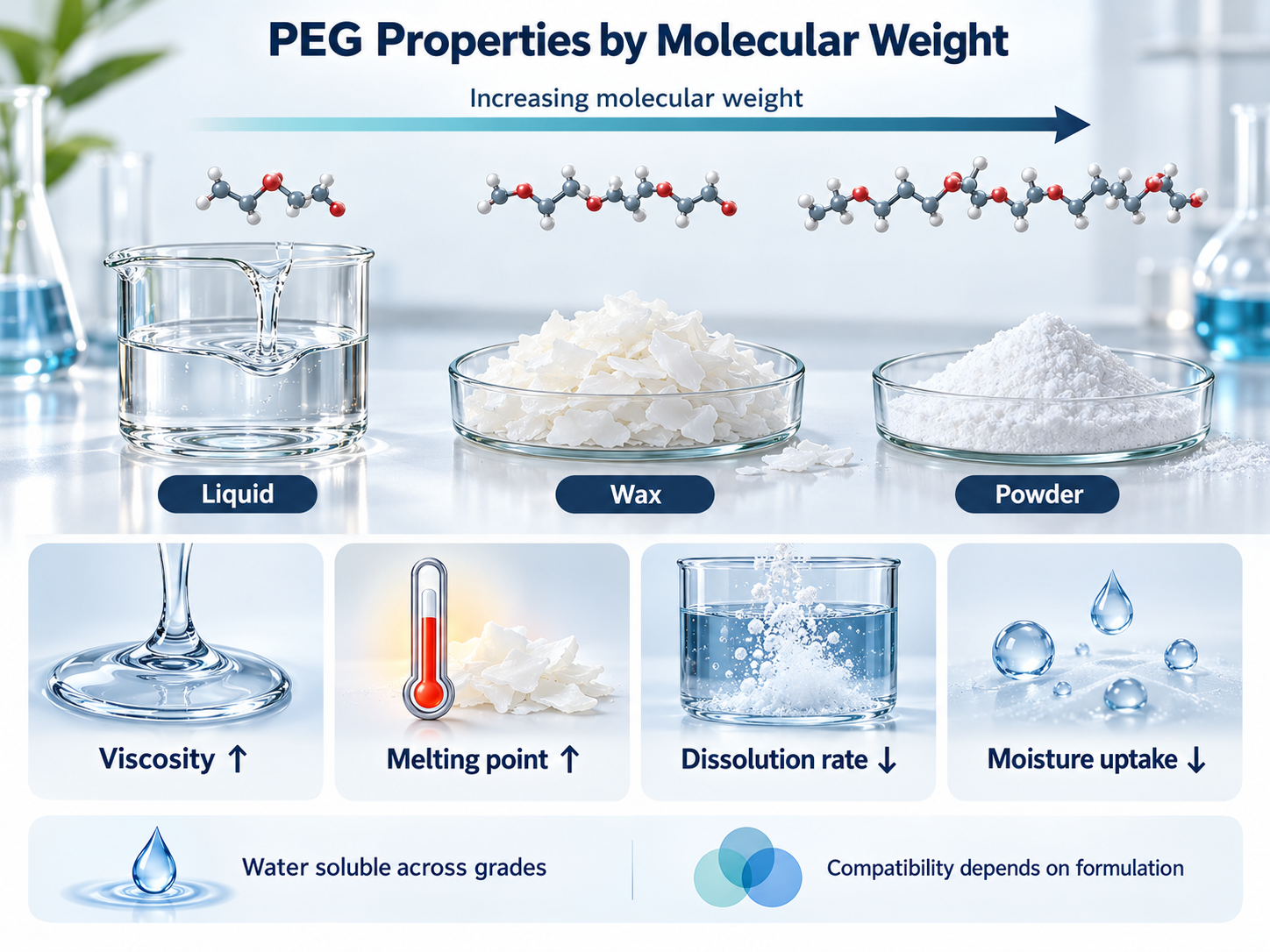
As molecular weight increases across the PEG range, several key property shifts occur.
Viscosity and physical form change first: lower molecular weight grades remain liquid, while higher grades solidify into waxes or powders due to increased chain length and intermolecular interaction. Water solubility follows a related pattern. All PEG grades are water soluble, but the rate of dissolution decreases somewhat as molecular weight increases, which affects dissolution behavior in aqueous systems.
Melting point rises progressively with molecular weight, a critical factor for applications involving heat processing, such as hot melt formulations or coatings. Hygroscopicity moves in the opposite direction: lower molecular weight grades absorb atmospheric moisture more readily, which is advantageous in humectant applications but may be undesirable in moisture sensitive processes.
Compatibility is equally important. Molecular weight influences how well PEG blends with active pharmaceutical ingredients, resins, pigments, or other excipients, which in turn affects formulation stability. Understanding these relationships allows formulators to narrow down grade selection before running compatibility trials, saving development time.
Industrial Applications of Polyethylene Glycol by Sector
Pharmaceutical Industry: PEG grades serve as excipients in tablet coatings, ointment bases, suppository formulations, and as solubility enhancers for active pharmaceutical ingredients. Lower grades act as solvents, while higher grades function as binders and coating agents.
Cosmetics and Personal Care: PEG is used as an emollient, emulsifier, and humectant in creams, lotions, shampoos, and skincare formulations, with grade selection influencing texture and skin feel.
Textile Processing: PEG functions as a lubricant, softener, and antistatic agent in fiber processing and textile finishing, improving fabric handling during manufacturing.
Paints and Coatings: Certain PEG grades act as plasticizers and dispersing aids, contributing to film flexibility and pigment dispersion.
Agrochemicals: PEG is used as a carrier, dispersant, or stabilizer in pesticide and herbicide formulations, aiding uniform distribution of active ingredients.
Industrial Manufacturing: PEG serves as a mold release agent, lubricant, and processing aid in metalworking, ceramics, and polymer processing applications.
This wide ranging applicability is precisely why industrial buyers need a supplier capable of manufacturing multiple PEG grades under consistent quality standards, rather than sourcing from multiple vendors with variable specifications.
How to Select the Right PEG Grade for Your Formulation
When evaluating which Polyethylene Glycol grade suits a particular application, consider the following factors:
- Required physical form: liquid, semi solid, or solid, based on the processing method.
- Desired melting point: particularly important for hot melt or coating applications.
- Solubility and dissolution requirements: relevant for pharmaceutical and agrochemical formulations.
- Compatibility with other formulation components, including actives, resins, or pigments.
- Regulatory requirements, especially for pharmaceutical grade or cosmetic grade applications requiring specific purity standards.
- End use performance expectations, such as film flexibility, lubrication, or binding strength.
In many cases, formulators use blends of two or more PEG grades to achieve intermediate properties that a single grade cannot deliver, a practice that benefits from supplier guidance grounded in formulation experience.
Factors to Consider When Selecting a PEG Supplier
Beyond grade selection, the choice of Polyethylene Glycol manufacturer significantly impacts formulation consistency and production reliability. Key evaluation criteria include:
- Manufacturing consistency: Batch to batch uniformity in molecular weight distribution and purity.
- Technical support: Access to formulation guidance and grade selection assistance from experienced chemists.
- Quality control infrastructure: In house testing capabilities to verify specifications before dispatch.
- Range of grades offered: A manufacturer producing multiple PEG grades reduces the need for multi vendor sourcing.
- Supply reliability: Consistent production capacity to meet ongoing industrial demand without disruption.
- Industry experience: A track record of serving pharmaceutical, cosmetic, textile, and industrial customers reflects broader application knowledge.
About RIMPRO India
RIMPRO India is a specialty chemical and surfactant manufacturer that produces Polyethylene Glycol across multiple molecular weight grades for pharmaceutical, cosmetic, textile, paint, agrochemical, and general industrial use. The company’s PEG grades are formulated to meet the viscosity, solubility, and stability requirements discussed throughout this article, giving formulators a dependable base for solvents, emulsifiers, binders, lubricants, and plasticizers depending on the grade selected. RIMPRO India works directly with procurement teams and formulation specialists to recommend the appropriate grade or grade blend for a given application, supported by consistent manufacturing quality, in house quality control, and reliable supply. For industries that depend on precise PEG performance, this combination of technical guidance and manufacturing consistency helps reduce formulation risk and keeps production running smoothly.
Choosing the Right PEG Grade with a Trusted Manufacturer
Selecting the right Polyethylene Glycol grade comes down to understanding how molecular weight influences viscosity, solubility, melting behavior, and compatibility within a formulation. From liquid grades like PEG 400 to solid grades like PEG 6000 and above, each variant serves distinct roles across pharmaceutical, cosmetic, textile, paint, agrochemical, and industrial applications.
Making the right choice also depends on working with a manufacturer that understands real world formulation challenges. With decades of specialty chemical manufacturing experience and application specific technical guidance, RIMPRO India helps industrial buyers, formulation developers, and OEM companies identify the PEG grade best suited to their requirements, backed by dependable, consistent supply.