
Fatty Alcohol Ethoxylate Selection: Why HLB Value and EO Level Matter
Selecting the right Fatty Alcohol Ethoxylate is a technical decision, not a routine sourcing task, since it directly governs wetting, emulsification, foaming, detergency, and solubilization across detergents, textiles, cosmetics, agrochemicals, paints, and industrial cleaning formulations. Performance is driven primarily by two parameters — HLB value (Hydrophilic-Lipophilic Balance) and EO level (degree of ethoxylation) — which together determine solubility, emulsifying capacity, and compatibility with other formulation components. Many procurement managers and formulation developers struggle to translate datasheet numbers into predictable in-use performance without deep surfactant chemistry experience. RIMPRO India, a specialty chemical manufacturer with over 25 years of experience in surfactant chemistry, works with formulation teams across these exact decision points, supplying detergent, textile, cosmetic, pharmaceutical, agrochemical, and coatings businesses. This guide explains how HLB value and EO level drive Fatty Alcohol Ethoxylate selection and application suitability.
Why Fatty Alcohol Ethoxylates Are Central to Industrial Formulations
Composition and Functional Versatility
Fatty Alcohol Ethoxylates are produced by reacting fatty alcohols — typically derived from natural fats, oils, or synthetic sources — with ethylene oxide under controlled conditions. The resulting non-ionic surfactant molecules contain a hydrophobic alkyl chain and a hydrophilic polyoxyethylene chain, giving them the dual affinity that makes surfactants functional in the first place. Because they are non-ionic, these surfactants remain stable across a wide pH range, tolerate electrolytes and hard water reasonably well, and are generally compatible with anionic, cationic, and amphoteric surfactants in blended systems — which is why they are used so extensively as industrial surfactants across heavy-duty detergents and specialty formulations alike.
The Variables That Determine Performance
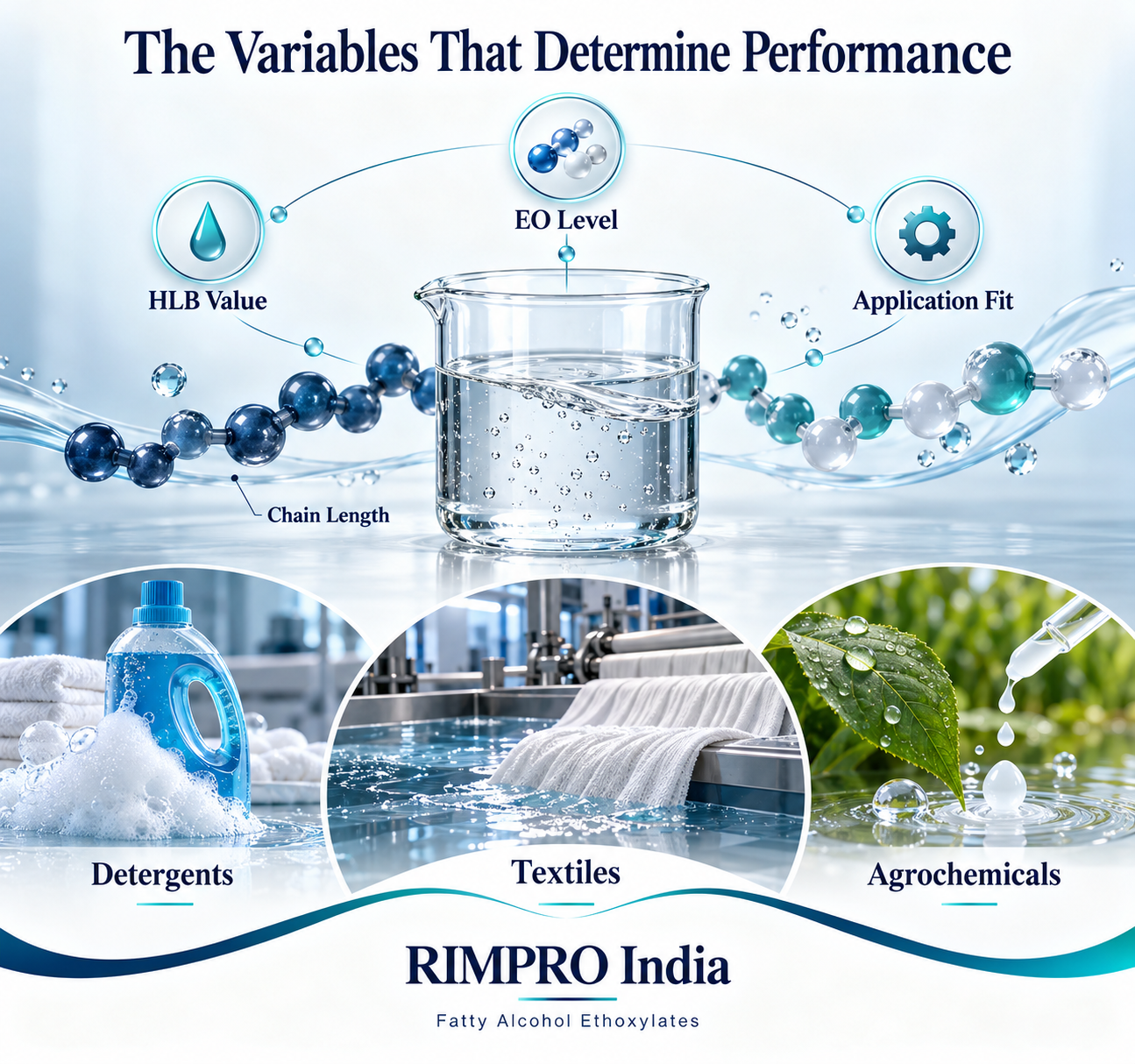
The performance of any given grade is not fixed. It shifts with chain length of the fatty alcohol, the number of ethylene oxide units attached, and the application it is deployed in. This is where HLB value, EO level, and application suitability become the three practical tools for selection, since the same grade can perform very differently across a detergent base, a textile process bath, or an agrochemical emulsion.
Selection Challenges and RIMPRO India’s Role
Selecting the correct grade is rarely straightforward. Formulation and procurement teams commonly face:
- Datasheets that list HLB and EO values without clear guidance on real-world performance
- Inconsistent EO distribution between supplier batches
- Difficulty matching a surfactant to specific water hardness or processing temperature conditions
- Confusion between chemically similar grades that behave quite differently once inside a formulation
RIMPRO India, a specialty chemical manufacturer with over 25 years of experience in surfactant chemistry, has built its Fatty Alcohol Ethoxylate manufacturing and technical support processes specifically to address these challenges — helping detergent, textile, cosmetic, pharmaceutical, agrochemical, and coatings manufacturers match HLB value and EO level requirements to their actual formulation and process conditions rather than to specification sheets alone.
Understanding HLB Value in Fatty Alcohol Ethoxylates
How HLB Value Determines Surfactant Behavior
HLB value of surfactants is a numerical scale, typically ranging from 1 to 20, that indicates the relative balance between the hydrophilic and hydrophobic portions of a surfactant molecule. A lower HLB value indicates a surfactant with stronger lipophilic (oil-loving) character, while a higher HLB value indicates stronger hydrophilic (water-loving) character.
For Fatty Alcohol Ethoxylates, HLB value increases as EO content increases, because each additional ethylene oxide unit adds hydrophilic character to the molecule while the hydrophobic alkyl chain remains constant. This relationship is what allows formulators to fine-tune a surfactant’s functional role simply by selecting a grade with a different EO level.
HLB Ranges and Their Functional Applications
As a general technical reference:
- HLB 3–6: Suited for water-in-oil emulsification and low-foam applications.
- HLB 7–9: Useful as wetting agents and intermediate emulsifiers.
- HLB 10–13: Common range for oil-in-water emulsification and general-purpose detergency.
- HLB 13–18: Suited for solubilization, high detergency, and applications requiring strong water dispersibility.
These ranges are guidelines rather than absolute rules. Actual performance also depends on the specific formulation matrix, co-surfactants used, temperature conditions, and the nature of the oil or soil phase being emulsified or removed.
The Role of EO Levels in Fatty Alcohol Ethoxylate Performance
Low EO vs High EO Fatty Alcohol Ethoxylates
The difference between low EO and high EO surfactants is one of the most frequent points of confusion for procurement and formulation teams new to surfactant sourcing.
Low EO Fatty Alcohol Ethoxylates (typically 2–5 moles of ethylene oxide) tend to be oil-soluble or dispersible, exhibit lower water solubility, and function well as emulsifiers in oil-continuous systems, defoamers, and certain agrochemical carriers. High EO grades (typically 7–12 moles or higher) are more water-soluble, exhibit stronger detergency and foaming characteristics, and are widely used in liquid and powder detergent formulations, industrial cleaners, and textile processing aids.
How EO Level Affects Solubility, Foaming and Wetting
As EO level increases, cloud point generally rises, water solubility improves, and foaming tendency changes depending on the alkyl chain length paired with it. This is why two Fatty Alcohol Ethoxylates with the same EO mole number but different carbon chain lengths (for example, C12-14 versus C16-18) will not perform identically — chain length and EO level interact to determine the final HLB value, solubility profile, and application fit.
For formulators evaluating how EO level in Fatty Alcohol Ethoxylates affects performance, the practical takeaway is that EO level should never be assessed in isolation. It must be considered alongside alkyl chain distribution, intended dilution ratio, water hardness of the end-use region, and compatibility with other surfactants or actives in the formulation.
Key Factors to Consider When Selecting a Fatty Alcohol Ethoxylate
Selecting the right grade for a specific application involves evaluating several interconnected factors:
- Required HLB value based on the emulsification or solubilization task at hand.
- Alkyl chain length distribution, which affects biodegradability, foaming, and detergency.
- Cloud point, particularly important for formulations exposed to temperature variation during processing or storage.
- Compatibility with other surfactants, actives, builders, or electrolytes in the formulation.
- Regulatory and biodegradability requirements, especially for detergent and personal care applications.
- Raw material consistency, since batch-to-batch variation in EO distribution can affect formulation reproducibility at scale.
Why Manufacturing Consistency Matters
This is a point where consistent manufacturing quality becomes directly relevant to formulation outcomes. RIMPRO India’s production processes are structured around controlled ethoxylation and quality verification at each stage, which helps ensure that the EO distribution and HLB characteristics stated on a technical datasheet are what formulators actually receive batch after batch — a factor that matters considerably when a formulation has been validated around a specific grade.
Application Suitability Across Industries
Detergents and Household Cleaning Formulations
In detergent and cleaning formulations, Fatty Alcohol Ethoxylates with higher EO levels are typically preferred for their detergency, water solubility, and compatibility with anionic surfactants such as LABSA and SLES. Formulators selecting a Fatty Alcohol Ethoxylate suitable for detergents generally look at HLB values in the 12–15 range, balanced against foam control requirements for machine-wash versus hand-wash products.
Textile Processing and Wet Processing Chemicals
Textile chemical manufacturers rely on Fatty Alcohol Ethoxylates as scouring agents, wetting agents, and levelling aids during dyeing and finishing processes. Mid-range HLB grades are common here, chosen for their ability to wet fabric surfaces efficiently while remaining compatible with dyes, auxiliaries, and processing temperatures used in textile wet processing.
Cosmetics and Personal Care Formulations
In cosmetic and personal care applications, Fatty Alcohol Ethoxylates function as emulsifiers, solubilizers, and mildness modifiers in cleansing formulations. Selection here is particularly sensitive to purity, odor profile, and skin compatibility, in addition to standard HLB and EO considerations.
Agrochemical Formulations
Agrochemical companies use Fatty Alcohol Ethoxylates primarily as emulsifiers in emulsifiable concentrates and as dispersants in suspension concentrates. Lower to mid EO grades are frequently selected to achieve stable emulsification of active ingredients dissolved in solvent systems.
Paints, Coatings and Industrial Cleaning
Paint and coating formulators use these surfactants as wetting and dispersing agents for pigments and fillers, while industrial and institutional cleaning formulations use higher EO grades for their detergency and rinse characteristics on hard surfaces.
Common Challenges in Fatty Alcohol Ethoxylate Selection
Formulation and procurement teams commonly encounter a few recurring challenges when selecting non-ionic surfactants:
- Difficulty translating datasheet HLB and EO values into predictable in-formulation performance without pilot trials.
- Batch-to-batch inconsistency from suppliers with limited process control, leading to reformulation issues at scale.
- Confusion between chemically similar grades that differ meaningfully in chain length distribution.
- Limited technical support during the selection phase, resulting in trial-and-error sourcing decisions.
How to Address These Challenges
Addressing these challenges typically requires working with a manufacturer that can provide application-specific technical guidance rather than datasheets alone — matching HLB and EO requirements to the formulator’s actual process conditions, water quality, and co-ingredient compatibility.
Evaluating a Fatty Alcohol Ethoxylate Manufacturer and Supplier
What to Look for When Evaluating a Supplier
When evaluating a Fatty Alcohol Ethoxylate supplier, industrial buyers should look beyond price and assess manufacturing consistency, technical support capability, and supply reliability. Questions worth asking include:
- Does the manufacturer control ethoxylation parameters closely enough to guarantee consistent EO distribution?
- Can their technical team assist in selecting or customizing a grade for a specific application rather than offering only standard catalog products?
- Does the supplier have experience across your specific industry — detergents, textiles, cosmetics, agrochemicals, or coatings — rather than a generic one-size-fits-all approach?
How RIMPRO India Meets These Criteria
RIMPRO India has built its position as a specialty chemical manufacturer around these exact evaluation criteria, offering both standard Fatty Alcohol Ethoxylate grades and custom surfactant solutions developed in consultation with formulation teams. This includes supporting customers through the selection process itself — reviewing formulation requirements, water conditions, and processing parameters to recommend an appropriate HLB and EO range rather than leaving that determination entirely to the buyer.
About RIMPRO India
RIMPRO India is a specialty chemical manufacturer focused on Fatty Alcohol Ethoxylates and related non-ionic surfactants for industrial formulations. The company helps detergent, textile, cosmetic, pharmaceutical, agrochemical, and paint and coating manufacturers select the right HLB value and EO level for their specific process, rather than choosing a grade from a catalog alone. Through controlled ethoxylation, in-house R&D, and application-specific technical support, RIMPRO India assists formulation and procurement teams in evaluating chain length, cloud point, and compatibility requirements, and can develop custom Fatty Alcohol Ethoxylate grades where standard HLB or EO ranges do not fit a formulation’s needs.
Choosing the Right Fatty Alcohol Ethoxylate for Your Application
Selecting the right Fatty Alcohol Ethoxylate comes down to understanding how HLB value and EO level interact with chain length, application conditions, and formulation compatibility — there is no universal “best” grade, only the grade suited to a specific process and performance requirement. Procurement teams and formulation developers who approach selection with this technical framework, rather than relying on generic specifications, are better positioned to avoid reformulation delays and performance inconsistencies. As a specialty chemical manufacturer with over 25 years of experience in surfactant chemistry, RIMPRO India works alongside detergent manufacturers, textile processors, cosmetic formulators, pharmaceutical companies, agrochemical businesses, and paint and coating producers to identify the right Fatty Alcohol Ethoxylate grade for their application, backed by consistent manufacturing quality and ongoing technical support throughout the sourcing and formulation process.