
Alkylphenol Ethoxylate in Industrial Cleaning and Formulation Processes
Alkylphenol Ethoxylate is a core building block in industrial cleaning chemicals, emulsion systems, and process formulations across multiple sectors. Its non-ionic surfactant properties make it a practical choice for formulators balancing cleaning efficiency, emulsification, and formulation stability. The sections below explain how it works and where it delivers the most value.
Why Alkylphenol Ethoxylate Matters in Industrial Formulations
Industrial formulators need surfactants that perform consistently across varying water hardness, temperature, and soil types. Alkylphenol Ethoxylate (APE) is one of the most widely evaluated non-ionic surfactants for industrial cleaning chemicals, emulsification systems, and specialty formulations, valued for its dependable wetting, detergency, and emulsifying performance.
How Alkylphenol Ethoxylate Improves Cleaning and Process Performance
As a non-ionic surfactant, Alkylphenol Ethoxylate reduces surface tension between water and oil-based soils, helping formulations penetrate, lift, and suspend contaminants. This mechanism supports its use across:
- Industrial degreasers and metal cleaning fluids
- Textile processing and dyeing auxiliaries
- Agrochemical emulsifiable concentrates
- Emulsion-based paints and coatings
Selecting the Right Alkylphenol Ethoxylate Manufacturer
Surfactant selection is rarely straightforward — batch consistency, HLB accuracy, and ethoxylation control all affect real-world performance, making the manufacturer as important as the chemistry. RIMPRO India supplies non-ionic surfactants engineered for consistent, application-specific performance across industrial cleaning and formulation processes.
What Is Alkylphenol Ethoxylate and How Does It Work?
Chemical Structure and HLB Mechanism
Alkylphenol Ethoxylate is produced by reacting an alkylphenol with ethylene oxide. The resulting molecule combines:
- A hydrophobic alkyl-phenol tail
- A hydrophilic polyethylene oxide chain
- An ethoxylate chain length that determines the hydrophilic-lipophilic balance (HLB)
HLB governs the surfactant’s solubility, foaming behavior, and suitability for a given application.
Stability Across Process Conditions
Because the molecule carries no ionic charge, it remains stable across a wide pH range and tolerates hard water and electrolytes better than many ionic surfactants. This is a primary reason formulators continue to specify Alkylphenol Ethoxylate for demanding industrial environments where water quality and process chemistry vary from site to site.
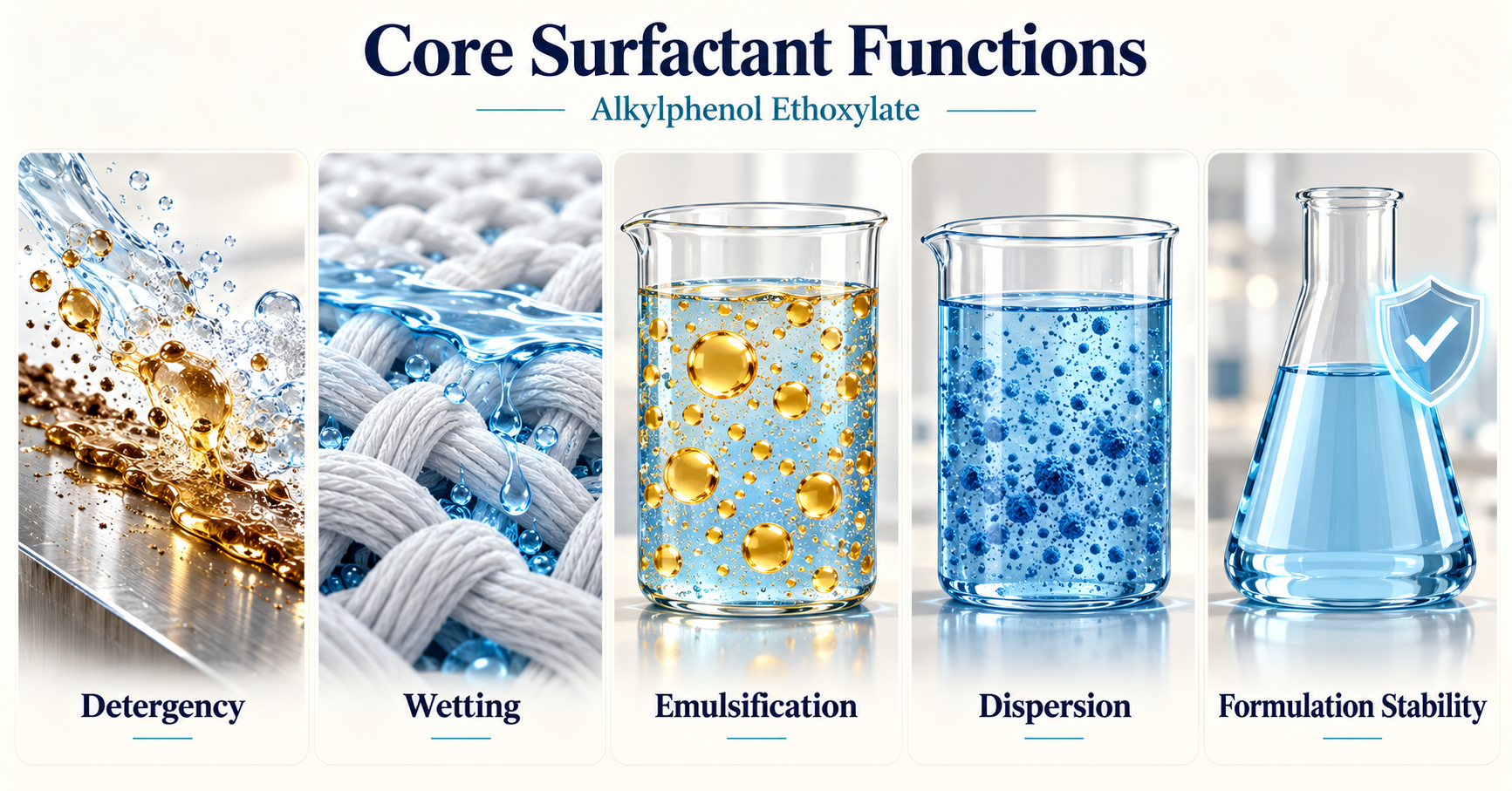
Core Surfactant Functions in Formulation
Alkylphenol Ethoxylate contributes several functional properties simultaneously, which is part of what makes it efficient in multi-purpose formulations:
- Detergency — lifting oils, greases, and particulate soils from metal, fabric, and hard surfaces.
- Wetting — reducing surface tension so cleaning or process fluids spread evenly and penetrate tight surfaces and fibers.
- Emulsification — stabilizing oil-in-water and water-in-oil systems in coatings, agrochemical concentrates, and processing fluids.
- Dispersion — keeping insoluble particles suspended, preventing settling or agglomeration during storage and application.
- Formulation stability — supporting compatibility between multiple actives, builders, and solvents in complex chemical blends.
Industrial Cleaning Applications of Alkylphenol Ethoxylate
Metal Cleaning and Degreasing
In metalworking and industrial maintenance, Alkylphenol Ethoxylate is used in alkaline cleaners and degreasers to remove cutting oils, lubricants, and buffing compounds prior to coating, plating, or assembly. Its wetting action helps cleaning solutions penetrate recessed geometries on machined parts, while its emulsifying capacity keeps removed oils suspended rather than redepositing on the cleaned surface.
Institutional and Industrial Detergents
Formulators of heavy-duty industrial detergents use Alkylphenol Ethoxylate to boost detergency in hard water conditions where anionic surfactants alone may lose efficiency. Combined with builders and co-surfactants, it helps maintain consistent cleaning performance across variable water hardness typical of large-scale industrial facilities.
Textile Processing
Textile chemical manufacturers apply Alkylphenol Ethoxylate in scouring, desizing, and dyeing auxiliary formulations, where its wetting and emulsifying properties assist in removing natural waxes, oils, and processing residues from fibers before dyeing. Even wetting supports uniform dye uptake, which is directly tied to fabric quality outcomes.
Agrochemical Formulations
In agrochemical adjuvant systems, Alkylphenol Ethoxylate functions as an emulsifier and dispersant for active ingredients in emulsifiable concentrates and suspension concentrates. It supports stable emulsion formation and consistent spray performance, which formulators depend on for product shelf life and field efficacy.
Paints, Coatings, and Industrial Emulsions
Paint and coating formulators use Alkylphenol Ethoxylate to stabilize pigment dispersions and maintain emulsion consistency during manufacturing and storage. Its role in preventing pigment agglomeration contributes to coating uniformity and finish quality.
Formulation Considerations When Working with Alkylphenol Ethoxylate
HLB Selection and Application Matching
Selecting the correct ethoxylation grade is central to formulation success:
- Lower ethoxylate grades favor oil-in-water emulsification and are often used in degreasing systems.
- Higher ethoxylate grades offer greater water solubility and suit detergent and wetting applications.
- HLB requirements should be evaluated against soil type, substrate, and process temperature.
Compatibility with Other Formulation Components
Alkylphenol Ethoxylate generally shows good compatibility with anionic surfactants, builders, and solvents commonly used in industrial formulations. However, compatibility testing remains important when introducing new actives, electrolytes, or co-surfactants, particularly in concentrated formulations where phase stability can be sensitive to component ratios.
Foaming Behavior and Process Requirements
Foaming characteristics vary with ethoxylation degree and concentration. In applications such as spray cleaning or high-agitation processing, formulators must account for foam generation and select grades or foam-control additives appropriate to the process equipment and cleaning method.
Water Hardness and Temperature Tolerance
Because Alkylphenol Ethoxylate is non-ionic, it maintains functional stability across variable water hardness and a broad temperature range, which is particularly valuable for industrial sites without consistent access to softened water or temperature-controlled process lines.
How to Select a Reliable Alkylphenol Ethoxylate Supplier
Formulation performance in the lab is only part of the equation; consistent performance at production scale depends heavily on supplier reliability. Procurement teams and formulation developers evaluating Alkylphenol Ethoxylate suppliers should consider the following factors.
Manufacturing Consistency and Quality Control
Batch-to-batch consistency in ethoxylation degree, moisture content, and color directly affects formulation reproducibility. A manufacturer with well-controlled ethoxylation processes and in-house quality testing reduces the risk of formulation drift between production runs.
Technical and Application Support
Because surfactant performance is application-dependent, a supplier’s ability to provide technical guidance on HLB selection, dosage optimization, and compatibility troubleshooting adds measurable value beyond the raw material itself. Suppliers with deep formulation chemistry backgrounds can help shorten development cycles for new industrial cleaning and process formulations.
Range of Application-Specific Grades
Since detergency, emulsification, and wetting applications each favor different ethoxylation grades, a supplier offering a range of Alkylphenol Ethoxylate grades allows formulators to fine-tune performance without switching chemistries entirely.
Supply Reliability and Scalability
Industrial buyers require dependable lead times and the capacity to scale volumes as production demand grows. Consistent raw material availability protects formulators from production interruptions tied to supply shortages, which is an increasingly important consideration for procurement managers managing multi-site operations.
Experience Across Industrial Sectors
A manufacturer with cross-sector experience — spanning industrial cleaning chemicals, textile auxiliaries, agrochemical adjuvants, and coatings — brings a broader base of formulation knowledge to technical discussions and product development.
Regulatory and Application-Fit Awareness
Surfactant selection increasingly involves evaluating regulatory requirements relevant to the end-use market and application, particularly for formulations destined for regulated sectors or export markets. Formulators should confirm application suitability and any relevant compliance requirements with their supplier before finalizing a formulation, and work with manufacturers who can provide accurate technical documentation to support this evaluation.
About RIMPRO India
RIMPRO India is a specialty chemical manufacturer supplying Alkylphenol Ethoxylate and other non-ionic surfactants to industrial cleaning, textile processing, agrochemical, and coatings formulators. Its Alkylphenol Ethoxylate grades are developed to support detergency, wetting, emulsification, and dispersion needs across these applications, backed by quality-controlled production and consistent supply. Formulation teams and procurement managers work with RIMPRO India to match the right ethoxylation grade to their process requirements, troubleshoot compatibility and stability questions, and secure a reliable supply for both established and new formulations.
Choosing a Reliable Alkylphenol Ethoxylate Manufacturer and Supplier
Alkylphenol Ethoxylate remains a versatile non-ionic surfactant across industrial cleaning, textile, agrochemical, and coating formulations, owing to its balanced detergency, wetting, emulsification, and dispersion properties. Getting the most value from it requires attention to HLB selection, compatibility testing, and process-specific performance — and a manufacturing partner equipped to support those decisions.