
Why Fatty Amines Ethoxylate Matters in Oilfield Chemical Formulations
Oilfield operations depend on chemical formulations that perform reliably under extreme pressure, high temperature, variable salinity, and aggressive downhole conditions. Among the surfactant classes used to meet these demands, Fatty Amines Ethoxylate has become a preferred building block for drilling fluids, corrosion inhibitor packages, demulsifiers, and production chemicals, valued for its tunable hydrophilic-lipophilic balance (HLB) and its role in emulsification, corrosion control, wetting, and dispersion. Formulators evaluating an ethoxylated amine surfactant typically weigh:
- Ethoxylation degree and resulting HLB
- Chain length and feedstock source
- Compatibility with other formulation additives
- Batch-to-batch consistency from the supplier
This is where RIMPRO India, a specialty chemical and surfactant manufacturer, supports formulators with quality-controlled Fatty Amines Ethoxylate manufacturing engineered for emulsification, corrosion control, and wetting performance in oilfield and industrial applications.
What Is Fatty Amines Ethoxylate?
Fatty Amines Ethoxylate belongs to the broader family of ethoxylated fatty amines, produced by the controlled addition of ethylene oxide units to a fatty amine backbone — typically derived from tallow, coco, oleyl, or stearyl amine feedstocks. The number of ethylene oxide (EO) moles attached determines the surfactant’s solubility, HLB value, and functional behavior.
Depending on the degree of ethoxylation, the resulting surfactant can behave as:
- A water-soluble, high-HLB surfactant suited for emulsification and dispersion.
- A low-HLB, oil-compatible surfactant suited for water-in-oil systems and corrosion film formation.
- An intermediate-HLB surfactant used in wetting and multi-functional formulations.
This tunability is precisely why oilfield chemical manufacturers rely on ethoxylated amines rather than single-function surfactants — one chemical platform can be adapted across several formulation requirements simply by adjusting the ethoxylation level.
Role of Fatty Amines Ethoxylate in Oilfield Chemical Formulations
Emulsification and De-emulsification
Oilfield production streams routinely contain mixtures of crude oil, water, and solids that must either be emulsified (for drilling and stimulation fluids) or de-emulsified (for crude oil dehydration and treatment). Fatty Amines Ethoxylate, due to its adjustable HLB, is used on both sides of this requirement.
In drilling fluid systems, ethoxylated amine surfactants help stabilize oil-in-water or invert emulsions, improving fluid rheology and lubricity. In production and midstream operations, structurally similar ethoxylated amines — often at higher molecular weights or blended with resins — function as demulsifiers, accelerating water separation from crude oil and reducing processing costs at the treatment facility.
Corrosion Control
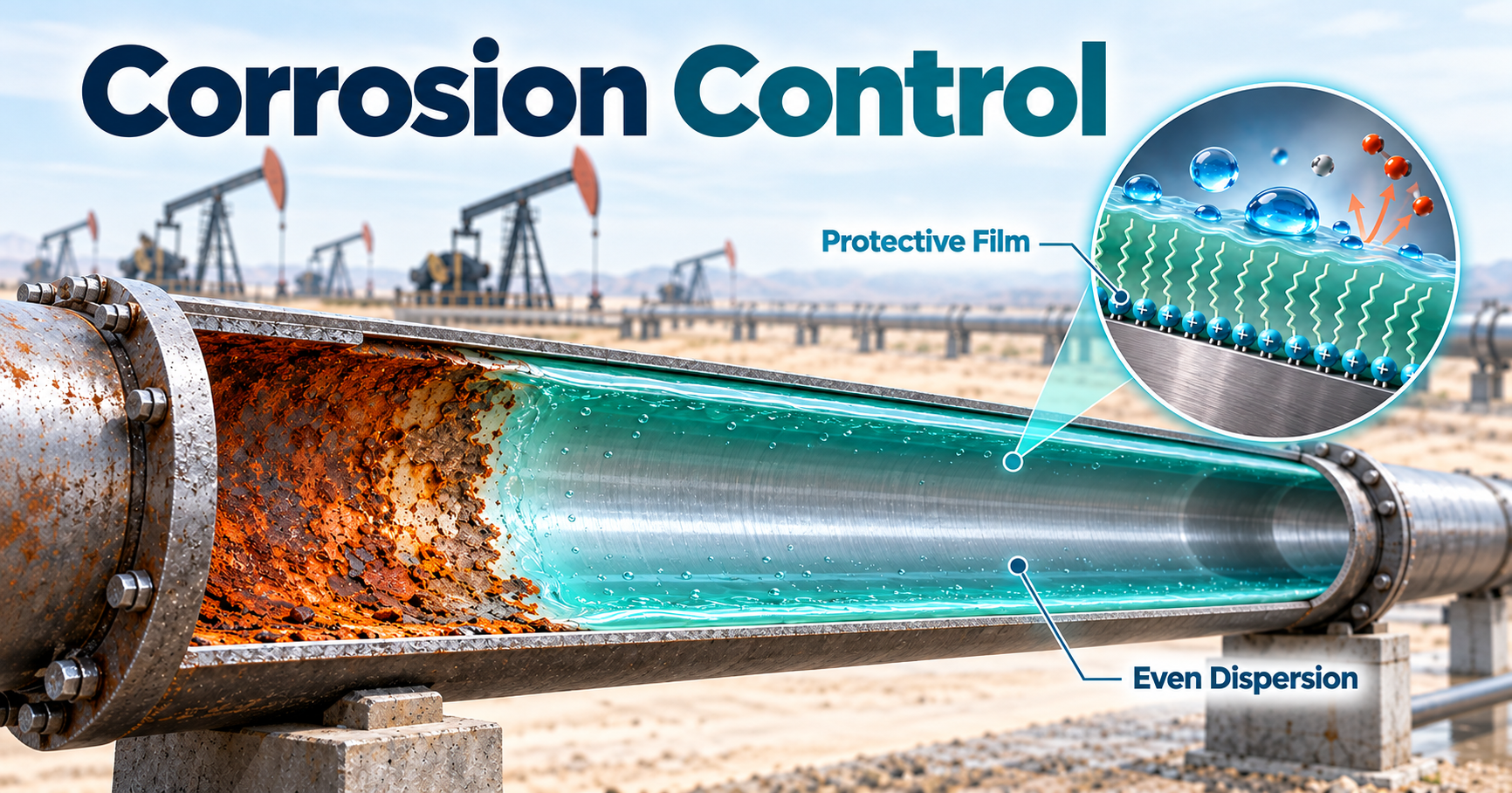
Corrosion is one of the most persistent challenges in oilfield infrastructure, driven by dissolved CO2, H2S, oxygen ingress, and high-salinity brine contact with steel tubulars, pipelines, and downhole equipment. Fatty amine derivatives, including their ethoxylated forms, are widely used as film-forming corrosion inhibitors.
The amine nitrogen provides an anchoring point that allows the molecule to adsorb onto metal surfaces, while the fatty chain forms a hydrophobic barrier that limits water and corrosive gas contact with the substrate. Ethoxylation further improves the molecule’s dispersibility in aqueous and multiphase systems, helping the corrosion inhibitor distribute evenly across pipeline surfaces rather than settling unevenly. This makes Fatty Amines Ethoxylate a functional intermediate in many corrosion inhibitor chemicals formulated for upstream and midstream oilfield applications.
Wetting and Dispersion
Effective wetting is essential in drilling fluids, workover fluids, and stimulation chemicals, where surfactants must reduce interfacial tension between fluid and rock or metal surfaces. Ethoxylated fatty amines act as wetting agents that improve fluid penetration into formations and help disperse solids such as barite, clay, and drill cuttings within the fluid system, reducing the risk of agglomeration and equipment fouling.
Compatibility with Other Oilfield Additives
Formulators frequently combine surfactants with biocides, scale inhibitors, corrosion inhibitors, and viscosifiers in a single package. Fatty Amines Ethoxylate is generally compatible with a wide range of these additives when correctly selected, and it can improve overall formulation stability by reducing phase separation in multi-component blends. This compatibility profile is a key reason formulation specialists continue to specify ethoxylated amine surfactants when designing new oilfield chemical packages.
Performance Enhancement Across Fluid Systems
Beyond individual functions, Fatty Amines Ethoxylate contributes to overall system performance by improving thermal stability, reducing foam-related complications when properly balanced, and supporting consistent performance across varying salinity and temperature profiles common in oilfield environments. This makes it applicable not only to drilling fluids but also to acidizing, fracturing, and production chemical formulations.
Key Selection Criteria for Oilfield Chemical Buyers
Choosing the right Fatty Amines Ethoxylate grade — and the right manufacturer — requires attention to several technical and operational factors:
Degree of ethoxylation: Determines HLB, solubility, and whether the product performs better as an emulsifier, wetting agent, or corrosion-inhibitor intermediate.
Feedstock and chain length: Influences thermal stability, biodegradability, and compatibility with the base fluid system.
Consistency of quality: Batch-to-batch variation in amine value, EO content, or color can affect formulation reproducibility, particularly in corrosion inhibitor and demulsifier applications where performance must be predictable in the field.
Regulatory and documentation support: Buyers increasingly require technical data sheets, safety documentation, and consistent COA (Certificate of Analysis) support for each batch supplied.
Supply reliability: Oilfield operations run on tight schedules; formulators need a chemical raw material supplier capable of consistent lead times and volume scalability.
Technical support: A manufacturer with in-house R&D can assist formulators in selecting the correct ethoxylation grade or recommending custom surfactant solutions for specific well conditions, rather than offering a one-size-fits-all product.
How RIMPRO India Supports Oilfield Chemical Formulators
RIMPRO India has built its manufacturing capability around specialty chemicals and surfactants, including Fatty Amines Ethoxylate, serving industries ranging from textiles and agrochemicals to oilfield and industrial process chemicals. This cross-sector manufacturing experience has shaped an approach focused on consistency, technical documentation, and application-specific customization for emulsification, corrosion control, and wetting requirements.
As a Fatty Amines Ethoxylate manufacturer, RIMPRO India works with formulation teams to understand the intended application — whether it is a corrosion inhibitor package, a demulsifier system, or a drilling fluid additive — and offers ethoxylation grades suited to that specific performance requirement. Quality-controlled production processes are used to maintain consistent amine value, EO content, and physical properties across production batches, which is particularly important for oilfield chemical manufacturers who cannot afford variability between shipments.
RIMPRO India’s in-house R&D team also supports custom surfactant development, allowing procurement managers and formulation specialists to work directly with chemists rather than relying solely on standard product datasheets. Combined with reliable supply capability for both domestic and international buyers, this positions RIMPRO India as a specialty chemicals manufacturer in India equipped to support the specific technical and volume needs of the oilfield chemicals sector.
For companies evaluating oilfield surfactant suppliers, working with a manufacturer that understands both the chemistry and the field application — rather than a generic chemical trader — reduces formulation risk and supports more predictable long-term performance.
About RIMPRO India
RIMPRO India manufactures Fatty Amines Ethoxylate for oilfield chemical formulations, supplying oilfield chemical manufacturers, formulation specialists, and R&D teams with grades engineered for emulsification, corrosion control, and wetting performance. The company’s Fatty Amines Ethoxylate is used to develop drilling fluid additives, corrosion inhibitor packages, and demulsifier systems, with in-house R&D and quality-controlled production supporting consistent EO content and amine value across batches. This focus on emulsification, corrosion control, and overall performance enhancement positions RIMPRO India as a dependable Fatty Amines Ethoxylate manufacturer and supplier for the oilfield chemicals sector.
Choosing the Right Fatty Amines Ethoxylate Manufacturer
Fatty Amines Ethoxylate continues to play a central role in oilfield chemical formulations, supporting emulsification, corrosion control, wetting, and dispersion across drilling, production, and midstream applications. Selecting the right grade — and the right manufacturing partner — is essential for consistent field performance.
As a specialty chemical and surfactant manufacturer, RIMPRO India helps oilfield chemical manufacturers, formulation specialists, and procurement teams solve emulsification, corrosion control, and wetting challenges through quality-focused production, technical guidance, and reliable supply of Fatty Amines Ethoxylate. Buyers looking for a consistent Fatty Amines Ethoxylate supplier can connect with RIMPRO India’s technical team to discuss application-specific requirements.