
Fatty Acid Ethoxylate: Role as an Emulsifying and Wetting Agent
Why Surfactant Chemistry Matters in Industrial Formulations
Industrial formulators face a recurring challenge: combining oil and water phases, distributing active ingredients evenly, and ensuring that a formulation performs consistently across manufacturing batches and real-world use conditions. Across detergents, textiles, agrochemicals, cosmetics, paints, and pharmaceuticals, this challenge is resolved through surfactant chemistry — and Fatty Acid Ethoxylate has become one of the most reliable and widely used non-ionic surfactants for the purpose. Its growing adoption across industrial sectors reflects a simple reality: formulation performance is only as strong as the surfactant system behind it.
What Fatty Acid Ethoxylate Is and How It Works
Fatty Acid Ethoxylate is produced by reacting fatty acids, derived from natural or synthetic sources, with ethylene oxide under controlled reaction conditions. The resulting molecule carries a hydrophobic fatty acid chain on one end and a hydrophilic polyethylene glycol chain on the other. This dual character allows it to function effectively as both an emulsifying agent and a wetting agent:
- Reduces interfacial tension between oil and water phases to form stable emulsions
- Lowers surface tension so liquids spread and penetrate solid or fibrous surfaces more evenly
- HLB (Hydrophilic-Lipophilic Balance) value, set by the degree of ethoxylation, determines exact behavior
- Allows formulators to select or customize a grade for emulsification, wetting, dispersing, or solubilizing needs
How Surfactant Properties Improve Formulation Stability and Dispersion
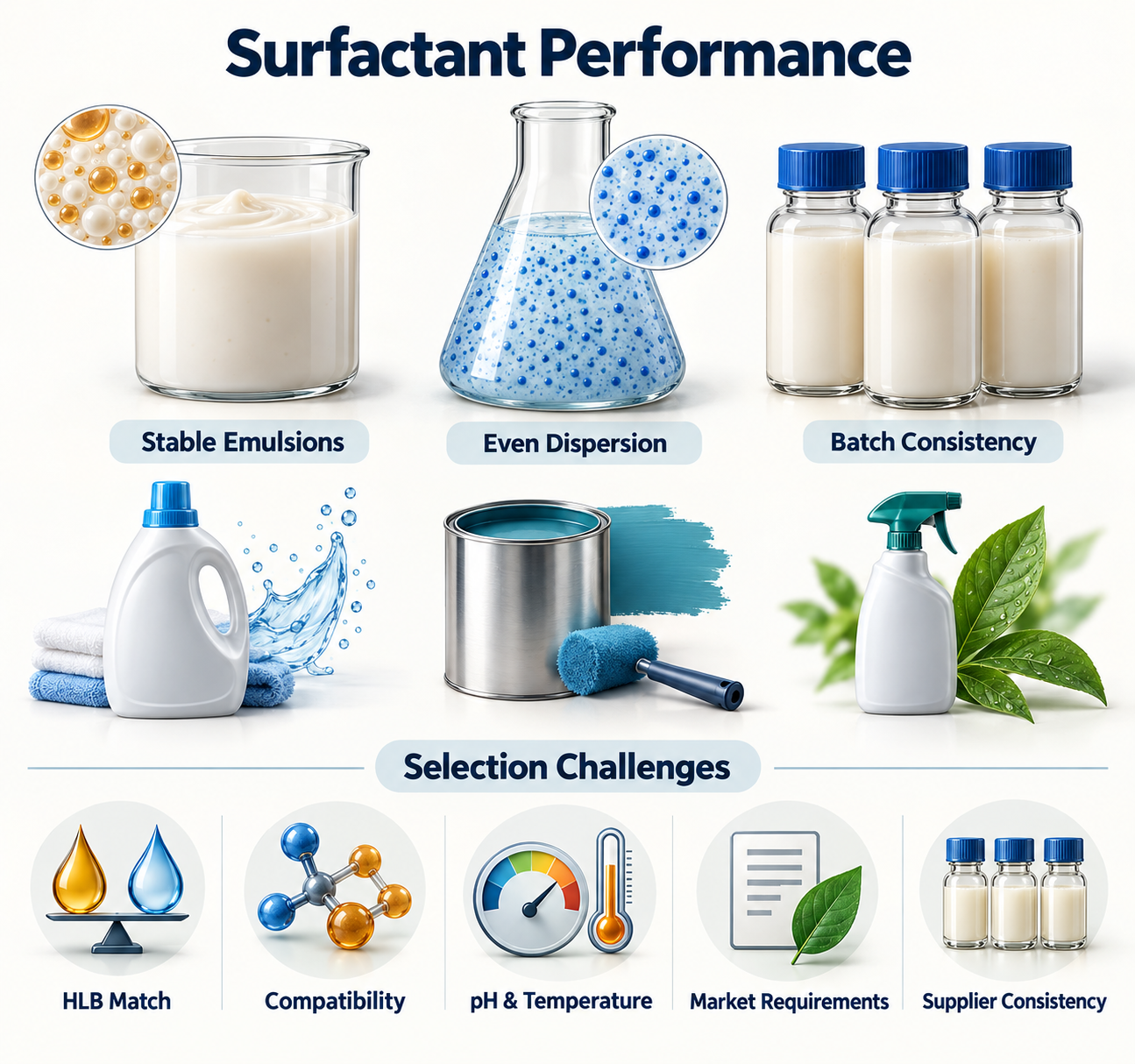
Beyond emulsification and wetting, these surfactant properties directly influence formulation stability, dispersion, and overall performance:
- Keeps emulsions from separating during storage and transport
- Improves even dispersion of pigments, actives, or oils throughout a formulation
- Supports consistent product behavior from batch to batch
These outcomes matter as much to a detergent manufacturer as they do to a paint formulator or an agrochemical producer.
Common Challenges in Selecting the Right Surfactant Solution
Despite its versatility, selecting the right surfactant solution is rarely straightforward. Formulation teams routinely face challenges such as:
- Matching HLB requirements to the target emulsion type
- Ensuring compatibility with other ionic or non-ionic surfactants and actives already in the system
- Maintaining stability across a range of pH, temperature, and storage conditions
- Meeting biodegradability and regulatory requirements for the target market
- Securing batch-to-batch consistency from a supplier
Generic product datasheets rarely answer these questions in full, which is why the choice of a Fatty Acid Ethoxylate manufacturer becomes as important as the underlying chemistry itself.
RIMPRO India’s Expertise in Fatty Acid Ethoxylate Manufacturing
This is where RIMPRO India’s experience becomes relevant to formulation teams and procurement managers alike. With over 25 years of specialty chemical and surfactant manufacturing experience, RIMPRO India operates as a non-ionic surfactant manufacturer and specialty chemicals manufacturer in India, producing Fatty Acid Ethoxylate grades for detergent, textile, agrochemical, paint, cosmetic, and pharmaceutical applications. As a Fatty Acid Ethoxylate supplier, RIMPRO India combines controlled, quality-focused production with application-specific technical guidance, helping formulation teams move past trial-and-error toward surfactant selections matched to their actual performance requirements.
Understanding Fatty Acid Ethoxylate as a Non-Ionic Surfactant
Fatty Acid Ethoxylates belong to the broader family of ethoxylated non-ionic surfactants, produced through the controlled addition of ethylene oxide units to a fatty acid backbone. Unlike ionic surfactants, non-ionic surfactants do not carry a charge in solution, which gives them distinct advantages: better compatibility with electrolytes, reduced sensitivity to water hardness, and lower foaming tendencies in many applications.
The degree of ethoxylation — the number of ethylene oxide (EO) units attached to the fatty acid chain — directly determines the surfactant’s HLB value and, consequently, its functional behavior. Lower EO content typically favors water-in-oil emulsification and lipophilic character, while higher EO content shifts the molecule toward hydrophilic behavior, favoring oil-in-water emulsification and enhanced wetting or solubilizing power. This tunability is a major reason formulation chemists favor Ethoxylated Fatty Acid derivatives: a single chemical family can be adjusted across a range of EO substitution levels to meet different formulation targets.
How Fatty Acid Ethoxylate Functions as an Emulsifier
Emulsification requires reducing the interfacial tension between two immiscible liquids so they can be dispersed into one another as fine droplets that resist separation over time. Fatty Acid Ethoxylate molecules orient themselves at the oil-water interface, with the hydrophobic fatty acid tail anchoring into the oil phase and the hydrophilic ethoxylate chain extending into the water phase. This orientation forms a stabilizing film around dispersed droplets, preventing coalescence and maintaining emulsion stability across storage and processing conditions.
This mechanism is particularly valuable in formulations that must remain stable through temperature fluctuations, mechanical agitation, or extended shelf life — conditions common in industrial lubricants, agrochemical concentrates, and personal care emulsions.
How Fatty Acid Ethoxylate Functions as a Wetting Agent
Why is Fatty Acid Ethoxylate used as a wetting agent? Wetting performance depends on a surfactant’s ability to lower the surface tension of a liquid so it spreads readily across a solid or fibrous substrate rather than beading up. Fatty Acid Ethoxylate accomplishes this by adsorbing at the liquid-air or liquid-solid interface, disrupting surface tension and allowing faster, more uniform contact between the liquid phase and the target surface.
This property is essential in textile processing, where dyes and finishing agents must penetrate fiber structures evenly, and in agrochemical formulations, where uniform spreading of active ingredients across leaf surfaces directly affects product efficacy.
Industrial Applications of Fatty Acid Ethoxylate
Detergents and Household Cleaning Formulations
In detergent manufacturing, Fatty Acid Ethoxylate contributes to grease and oil removal by emulsifying soils and lifting them away from fabric or hard surfaces. Its non-ionic nature allows compatibility with anionic and cationic surfactant systems commonly used in liquid and powder detergent formulations, supporting balanced foam control and improved cleaning efficiency, particularly in hard water conditions.
Textile Processing and Finishing
Textile chemical manufacturers rely on Fatty Acid Ethoxylate during scouring, dyeing, and finishing operations. Its wetting action improves dye uptake and levelness, while its emulsifying properties help remove waxes, oils, and processing residues from fiber surfaces before further treatment — supporting consistent fabric quality across production batches.
Agrochemical Formulations
In crop protection formulations, Fatty Acid Ethoxylate functions as an emulsifier for concentrate formulations (such as EC and EW formulations) and as a wetting agent that improves spray coverage on leaf surfaces. Better spreading and adhesion translate directly into improved absorption of active ingredients and more consistent field performance.
Paints, Coatings, and Industrial Process Chemicals
Paint and coating formulators use Fatty Acid Ethoxylate to stabilize pigment dispersions and improve wetting of pigment particles during the milling and dispersion stage. This reduces particle agglomeration, supports color consistency, and improves the overall stability of water-based coating systems.
Personal Care and Cosmetic Formulations
Cosmetic manufacturers use Fatty Acid Ethoxylate derivatives as mild emulsifiers in creams, lotions, and cleansing formulations, where consistent emulsion stability and skin-compatible mildness are essential. Its non-ionic character supports formulation stability across a range of pH and electrolyte conditions common in personal care products.
Pharmaceutical and Specialty Industrial Uses
Pharmaceutical formulators occasionally use ethoxylated fatty acid derivatives as solubilizing or emulsifying agents in topical and semi-solid formulations, where consistent, well-characterized raw material quality is a non-negotiable requirement.
Difference Between Emulsifying Agents and Wetting Agents
Although Fatty Acid Ethoxylate performs both roles, the underlying mechanisms differ. Emulsifying agents work primarily at the interface between two immiscible liquids, stabilizing droplets to prevent phase separation over time. Wetting agents, by contrast, work at the interface between a liquid and a solid or fibrous surface, reducing surface tension so the liquid spreads and penetrates more effectively.
A single surfactant molecule can perform both functions depending on formulation conditions, EO substitution level, and concentration — which is precisely why Fatty Acid Ethoxylate is valued as a multifunctional additive rather than a single-purpose ingredient.
Factors Affecting Surfactant Selection in Industrial Formulations
How to select the right non-ionic surfactant for a given application? Several technical factors guide this decision:
- Required HLB value for the target emulsion type (oil-in-water or water-in-oil)
- Compatibility with other surfactants, actives, and formulation components
- Thermal and pH stability across processing and storage conditions
- Foam behavior, particularly in detergent and cleaning applications
- Biodegradability and regulatory compliance for the target market and industry
- Batch-to-batch consistency, which directly affects downstream formulation reproducibility
These factors rarely exist in isolation, and formulation teams often need application-specific guidance rather than a generic product datasheet.
Choosing a Reliable Fatty Acid Ethoxylate Manufacturer
Formulation performance depends not only on surfactant chemistry but on the consistency and technical support behind the raw material supply. An experienced specialty chemical manufacturer brings several advantages to industrial buyers and formulation teams:
- Technical understanding of application requirements — recommending the appropriate EO substitution grade for a specific emulsification or wetting requirement, rather than leaving formulators to work through trial and error
- Quality-focused, controlled production processes — consistency in ethoxylation degree, free fatty acid content, and moisture levels directly affects formulation performance
- Research and development support — access to R&D capabilities lets formulation teams trial custom EO grades or blended surfactant systems
- Reliable supply and consistent quality across sectors — a broad, cross-industry understanding of formulation challenges translates into more informed technical support
RIMPRO India has built its position as a Fatty Acid Ethoxylate supplier around these principles, combining over two decades of surfactant manufacturing experience with application-focused technical guidance for formulation teams, procurement managers, and OEM partners across India and international markets. This approach reflects a broader commitment to being viewed not simply as a chemical raw material supplier, but as a technical partner in formulation development — offering custom surfactant solutions where standard grades do not fully meet a formulation’s requirements.
About RIMPRO India
RIMPRO India is a specialty chemical and surfactant manufacturer focused on producing Fatty Acid Ethoxylate and other non-ionic surfactants for detergent, textile, agrochemical, paint and coating, cosmetic, and pharmaceutical manufacturers across India and international markets. Manufacturing operations are built around controlled ethoxylation processes that keep HLB value, free fatty acid content, and moisture levels consistent from batch to batch — the specifications that directly determine how a Fatty Acid Ethoxylate grade performs as an emulsifying or wetting agent in a formulation. RIMPRO India works directly with formulation teams and procurement managers to match the right EO substitution grade to the application, offering custom Fatty Acid Ethoxylate solutions alongside technical support and dependable supply — positioning the company as a formulation partner rather than a transactional raw material vendor.
Fatty Acid Ethoxylate Manufacturer: Choosing the Right Supply Partner
Fatty Acid Ethoxylate remains one of the most functionally versatile non-ionic surfactants available to industrial formulators, capable of performing as both an emulsifying agent and a wetting agent depending on EO substitution level and formulation conditions. Its relevance spans detergents, textiles, agrochemicals, paints and coatings, personal care, and pharmaceutical formulations.
For procurement managers, R&D teams, and formulation developers, the choice of manufacturer matters as much as the chemistry itself — consistent quality, technical understanding, and dependable supply separate a commodity purchase from a genuine formulation partnership. With over 25 years of specialty chemical and surfactant manufacturing experience, RIMPRO India works alongside industrial buyers and formulation teams to supply Fatty Acid Ethoxylate grades suited to real-world application requirements.